Mining lives two lives
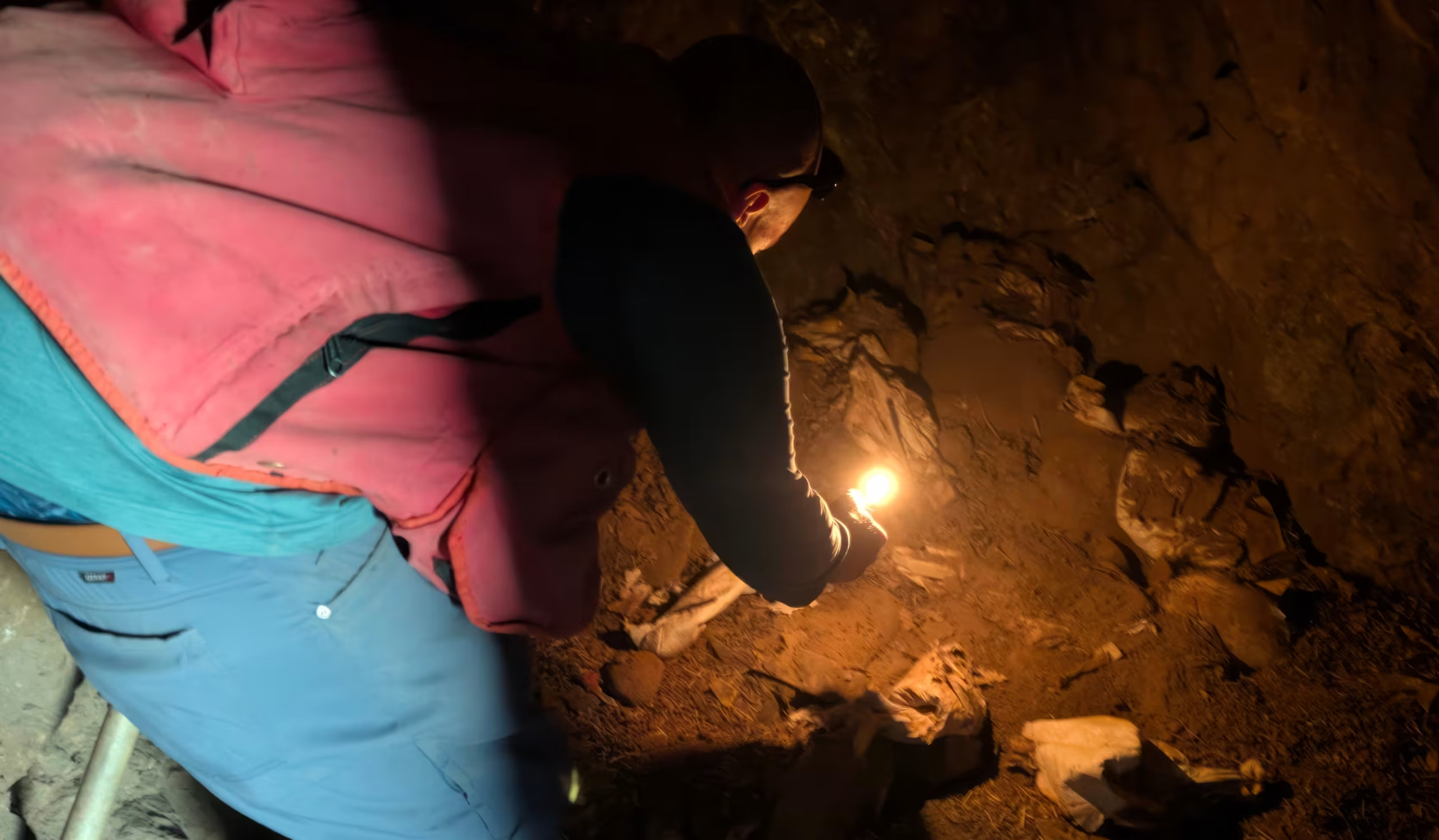
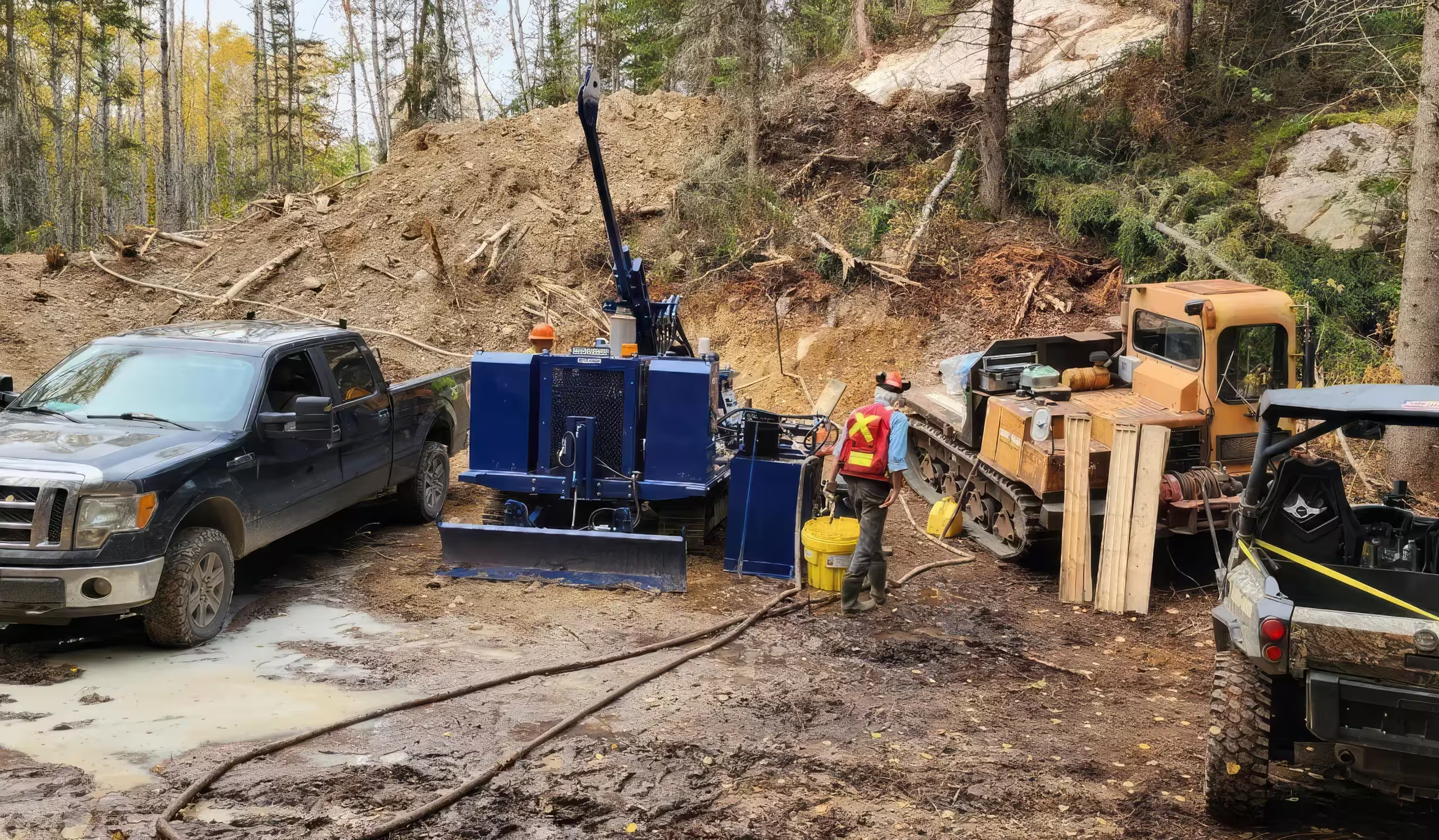
One is physical and it is measured in drill metres and core trays, in core boxes stacked like firewood, in long days when the sun cooks everything beyond the shade and the dust somehow finds every gap in your boots and clothes.
This is the life of the ground where mineralised systems rarely behave exactly as the first model predicts. They bend, pinch, disappear, reappear and force us to change our minds.
This is geology tested against fact. It is drilled, sampled, logged, interpreted, challenged, revised and, ultimately, paid for in real money.
The other life exists largely on paper and screens and it is carried through announcements, technical reports, investor presentations, tables, cross-sections, diagrams and carefully chosen verbs. Most investors will never touch a piece of your core. They will never smell fresh sulphides coming out of a tray, never watch a rig grind its way through the ground. They meet your project through the second life only.
Reporting standards such as the JORC Code and NI 43-101 do not exist to punish technical teams with bureaucracy, or to turn every announcement into twenty pages of qualifications. They exist because the people making investment decisions need technical information to be clear, balanced and defensible.
A good announcement should allow an investor to understand not only what has been discovered, but also what is known, what is interpreted, what remains uncertain and who is taking professional responsibility for those conclusions.
Because once geological work enters the public market, words matter almost as much as drill holes.
A metre is still a metre, an assay is still an assay, but the way those results are selected, described and illustrated can materially change the story an investor takes away. That is where the risk begins.
Reporting protects credibility and credibility is capital and in mining, capital is oxygen. Exploration programs stop without it. Studies slow down. Drilling gets deferred. Projects that might otherwise have had a future begin to suffocate.
Once credibility starts to thin, everything becomes harder to breathe and that is where fatal flaws begin.
The $1 Billion a Quarter
Australia is not a small exploration market operating at the margins of global mining finance.
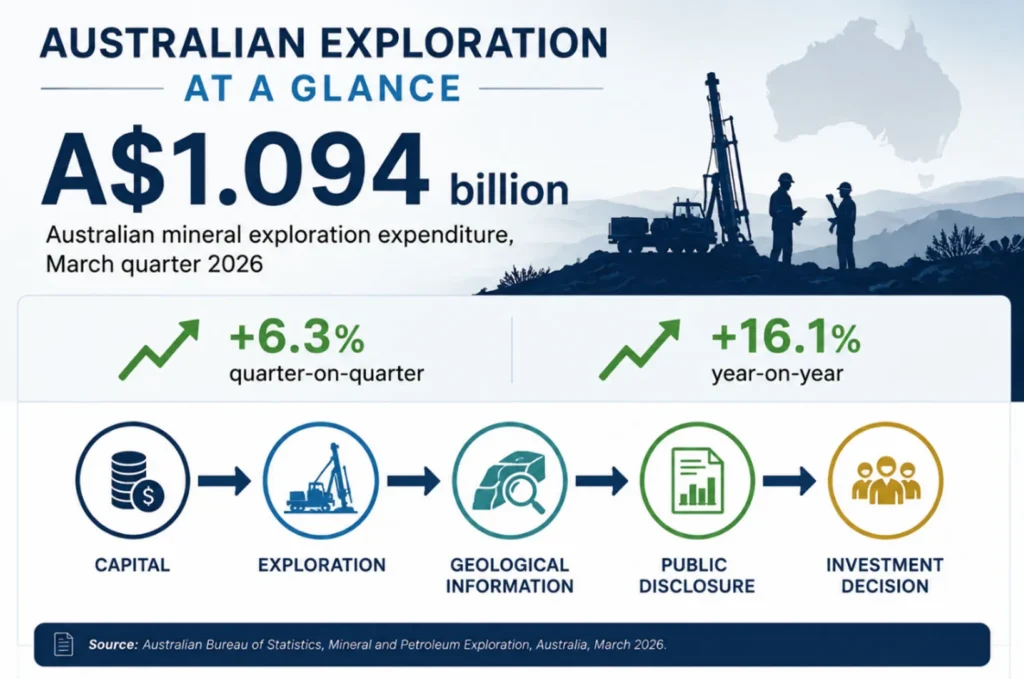
In the March quarter of 2026, Australian mineral exploration expenditure reached approximately A$1.09 billion on a seasonally adjusted basis, up 6.3% from the preceding quarter and 16.1% from a year earlier.
That is more than a billion dollars being spent in three months trying to convert geological uncertainty into investable knowledge.
And every meter drilled, every assay generated and every resource model constructed eventually encounters the same bottleneck it has to be communicated.
The Australian market has developed one of the world’s best-known systems for doing that. The JORC Code, together with Chapter 5 of the ASX Listing Rules and associated ASX guidance, creates the framework through which Exploration Results, Mineral Resources and Ore Reserves are communicated to investors. The purpose is not to make exploration conservative; it is to make it credible.
There is an important distinction. Exploration is inherently speculative. A geologist should be able to pursue a difficult idea, test an unconventional model and take geological risk.
Public disclosure is different. Public disclosure takes geological uncertainty and places it in front of people making financial decisions. That is why the threshold changes.
JORC Is Not a Geology Manual
This distinction matters because one of the most persistent misunderstandings about JORC is that it somehow determines how geology should be done. It does not. The JORC Code is principally a public reporting code.
It neither tells a geologist where to drill the next hole nor replaces professional judgement, and it certainly cannot guarantee that an exploration model is correct, that a Mineral Resource will become an Ore Reserve, or that a mine will ultimately make money.
What it does is impose discipline on the point where technical work becomes public information.
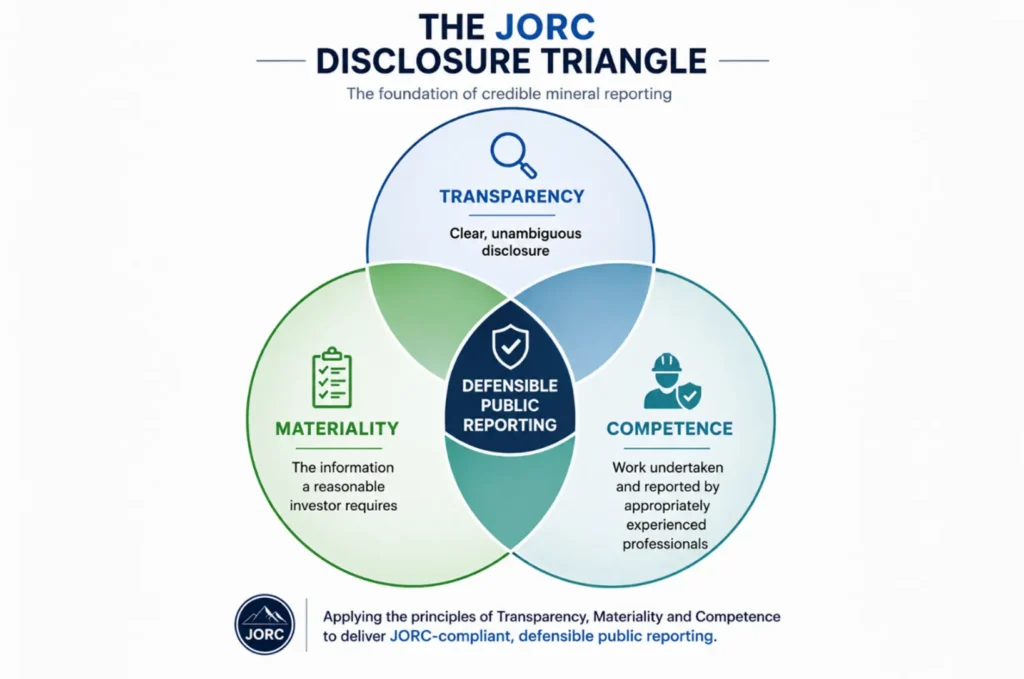
Three principles sit at the centre of that discipline:
Transparency
The reader should be given sufficient information, presented clearly and without ambiguity, to understand the report and not be misled by what has been said or by what has been omitted.
Materiality
A Public Report should contain the information that investors and their professional advisers would reasonably require and reasonably expect to find, for the purpose of making a reasoned and balanced judgement.
Competence
The technical information must be based on work for which appropriately experienced professionals accept responsibility.
The Fatal Flaw Is Rarely Fraud
Most bad disclosure does not begin with bad geology or fraud; more often, it begins with competent people doing sound technical work under pressure to explain why it matters, as interesting drilling, an improving geological model and emerging continuity naturally create a desire for the market to understand the significance of the results.
Then somebody has to compress three months of geology into a six-page announcement. That is where things begin to move. “May represent” becomes “represents”. “Interpreted continuity” becomes “continuity”. “Potential extension” becomes “extension”. Nothing new has been drilled, nothing new has been assayed, and the geology itself has not changed. Only the certainty of the language has.
Once that shift begins, it can move quickly. An Exploration Target starts to sound like a Mineral Resource. A Mineral Resource begins to acquire the confidence of an Ore Reserve. A mineralised interval becomes “ore”. An early metallurgical result is described as evidence of “strong project economics”. A conceptual production case appears in an investor presentation, while the assumptions and qualifications that made it technically defensible in the underlying work somehow fail to make it onto the slide.
Individually, each change may appear minor. Taken together, however, they can move the narrative to several technical stages ahead of the project itself. That is the real problem. It is not necessarily dishonesty, and it is not necessarily incompetence. It is simply language that has quietly become more confident than the evidence supporting it.
This is also where intent becomes a poor defence: the person drafting the announcement may know exactly what they meant, the geologist may understand every qualification behind the statement, and the board may have heard the full technical explanation, but the investor sees only the words that were ultimately published.
So the real question is not, “Did we intend to mislead anyone?” The more useful question is, “What conclusion would a reasonable investor take from what we actually published?” Because the market does not read the discussion that happened before release. It reads the release.
Geological Confidence Has Boundaries
Mining professionals routinely work with incomplete information, particularly during exploration, where uncertainty is not a sign of poor work but an inherent part of the process.
The reporting problem begins when the language implies more certainty than the evidence can support, because Exploration Results, Exploration Targets, Mineral Resources and Ore Reserves are not interchangeable milestones but distinct stages representing progressively different levels of geological knowledge and, ultimately, technical and economic confidence.
An Exploration Result may tell us that mineralisation exists. An Exploration Target expresses conceptual potential, but its quantity and grade remain uncertain and further exploration may not result in the estimation of a Mineral Resource. A Mineral Resource requires sufficient geological evidence, sampling and metallurgy to support classification and must satisfy the relevant requirement for reasonable prospects for eventual economic extraction.
An Ore Reserve goes significantly further. It represents the economically mineable part of a Measured and/or Indicated Mineral Resource after application of the relevant Modifying Factors and the required level of study.
Between an discovery hole and an Ore Reserve sits an enormous body of work. It merely makes the disclosure advance faster than the project.
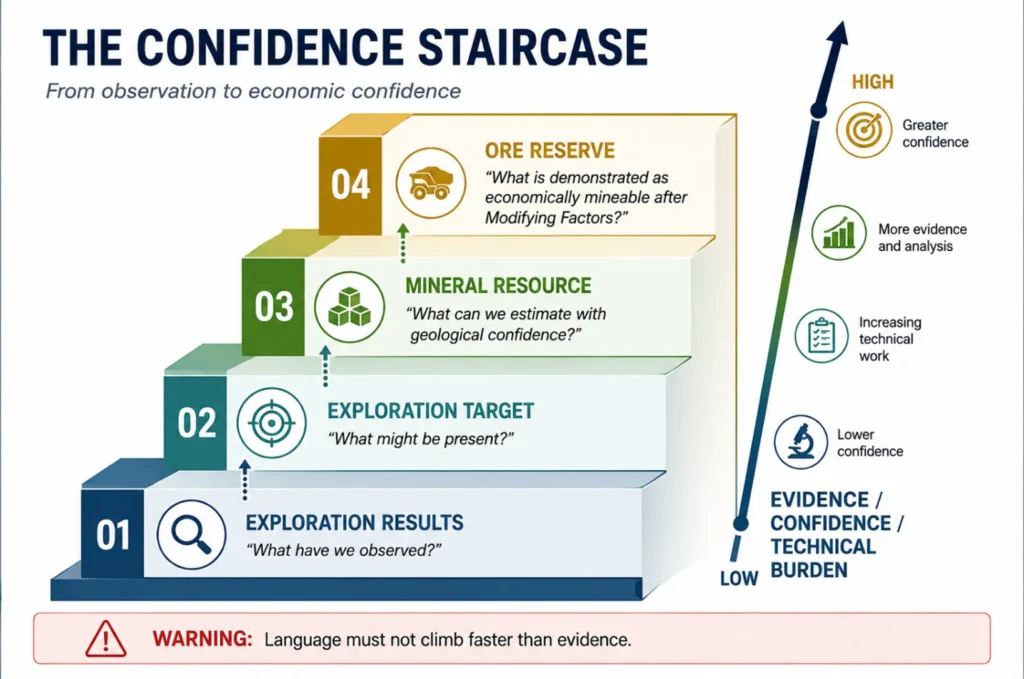
The Most Expensive Word in Exploration May Be “Ore”
The word is short, but its implications are not. In everyday mine-site conversation, people sometimes use “ore” loosely, and experienced practitioners generally understand what is meant from the context. Public reporting does not have that same luxury. Once the word appears in an announcement, presentation or technical report, an investor is entitled to understand something materially different from simply “mineralisation”.
An Ore Reserve has a specific technical meaning, and using the word “ore” before the necessary technical and economic work has been completed can imply a level of confidence that the project has not yet earned. What may sound like harmless shorthand inside the technical team can become something very different once it reaches the market.
The same problem applies to words such as “economic”, “mineable”, “commercial”, “high-grade”, “world-class”, “robust”, “viable”, “extension”, “continuity” and “significant”. None of these words is inherently prohibited, but each can carry substantially more meaning for an investor than the person drafting the announcement may intend. Technical shorthand becomes dangerous when it leaves the technical room.
What ultimately matters is how a reasonable investor would understand the statement when reading it without access to the technical discussions, assumptions and qualifications that sit behind it. That is a more demanding test, but it is also the one that best reflects how public disclosure is actually received.
Selective Truth Can Still Produce a Misleading Story
Another recurring disclosure problem is not incorrect information, but incomplete information. A company may publish numbers that are entirely accurate and still leave the market with an impression that the full dataset does not support.
Imagine a drilling program of twenty holes. One interval is spectacular, five are encouraging, seven are modest, and seven do little to support the current geological model. The spectacular interval absolutely deserves attention. The problem begins when the announcement effectively becomes the story of that one result, while the holes that constrain continuity, weaken the interpretation or simply fail to perform are pushed into the background.
Balanced reporting matters because the geological question is not simply, “What is the best result?” The more important question is, “What do the results, taken together, tell us about the mineralised system?” A single high-grade intercept may be significant, but it does not automatically demonstrate continuity, scale or repeatability.
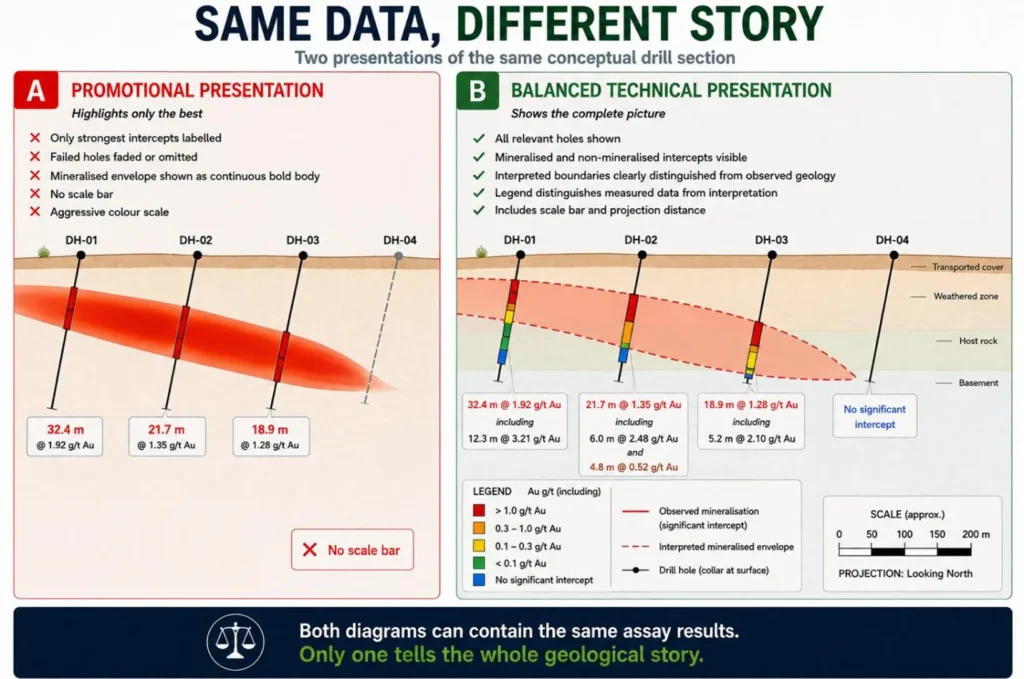
This becomes even more important when the information is presented visually. A cross-section can contain the correct drill hole. A long section can show the reported intersections. A plan can correctly identify the anomaly. And the figure can still create a misleading impression.
Scale, omitted holes, selective labelling, aggressive colour ranges, projected intersections and inferred geological boundaries all influence what the reader sees. The underlying data may be technically correct, but the presentation can still make the geology look more continuous, more coherent or more advanced than the evidence justifies.
JORC Table 1 Is Not an Appendix Nobody Reads
JORC Table 1 is sometimes treated as the compliance section added after the interesting part of an announcement has already been written. That misses its purpose. Used properly, Table 1 is not an afterthought; it is the mechanism that forces a technical team to slow down and confront the questions that an enthusiastic narrative can easily skate past.
It asks how the sample was collected, what was actually sampled, whether recovery was representative, how samples were prepared, which analytical methods were used and what QA/QC procedures were applied. It also asks how collar locations were established, whether reported intervals are downhole lengths or true widths, what is actually known about geological continuity, whether the data have been verified and, just as importantly, what information is still missing.
The real strength of Table 1 lies in the JORC principle of “if not, why not.” If a material item has not been addressed, the expectation is not that the omission simply disappears into the background. It should be explained. That shifts the exercise away from box-ticking and toward technical accountability.
A company does not need to have perfect information at every stage of exploration. Early-stage projects are, by definition, incomplete. But the disclosure should make clear what is known, what remains uncertain and what work has not yet been done. Properly disclosed uncertainty is not a weakness. Hidden uncertainty is.
The Competent Person Is Not a Ceremonial Signature
This may be one of the most important points for boards and executives to understand. Under JORC, public reporting of Exploration Results, Mineral Resources and Ore Reserves must be based on, and fairly reflect, supporting information and documentation prepared by a Competent Person. The Competent Person is not there simply because the announcement needs a name at the bottom. The role exists to provide technical accountability.
Competence is specific to the work being undertaken. A highly experienced iron ore resource geologist may still lack the relevant experience to take responsibility for a lithium brine project, a narrow-vein gold estimate, a lateritic nickel deposit, a coal reserve or a complex polymetallic system, because the key test is whether their experience is directly relevant to the style of mineralisation, the deposit type, the activity being performed and the technical judgement being made.
Years in the industry and professional standing both matter, but neither is enough on its own to justify responsibility for every technical discipline across mining. A practical internal test is to ask whether this is genuinely the person you would want explaining and defending the judgement if it were challenged by another specialist in the same field; if that answer is uncertain, the sign-off should be reconsidered.
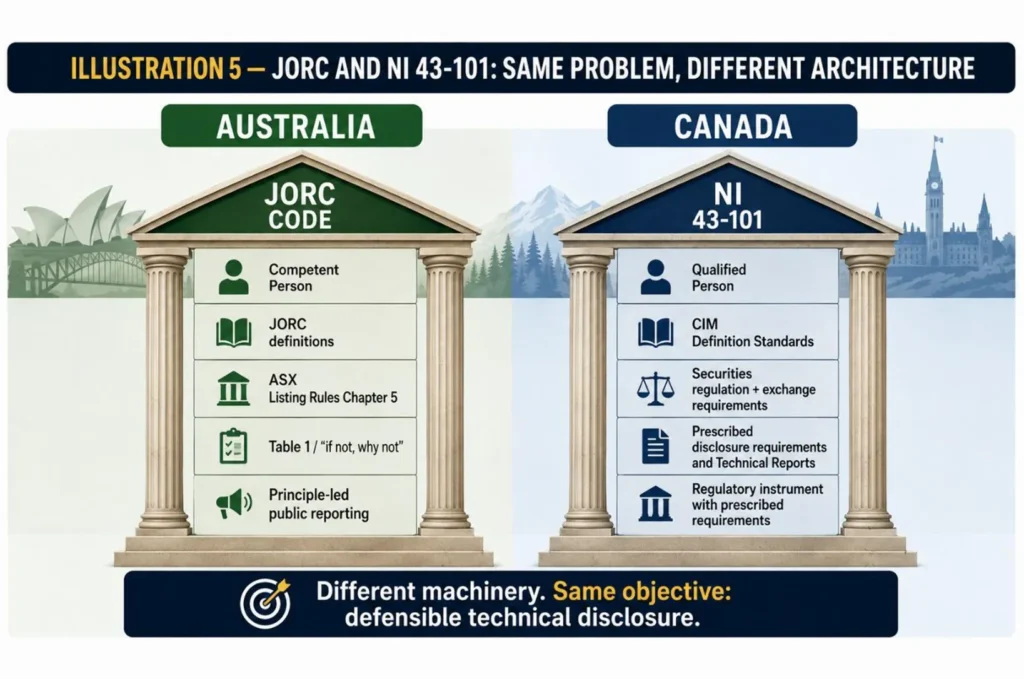
A Useful Canadian Comparison: NI 43-101
Canada approaches the same fundamental problem through a different regulatory scheme.
NI 43-101 centres technical disclosure around the Qualified Person, supported by CIM Definition Standards and, where triggered, a prescribed Technical Report framework.
The terminology and mechanics differ from JORC, but the governing philosophy is familiar: professional accountability, defined technical categories and disclosure that does not outrun the supporting evidence.
The Canadian framework is particularly useful because it makes one fact impossible to ignore: “Disclosure” is much broader than the formal technical report.
Technical information can appear in news releases, investor materials, corporate websites and other public communications.
The PDAC material makes this point repeatedly. Website disclosure, promotional wording, exploration targets, historical estimates and economic statements were all identified as areas capable of creating technical disclosure problems.
That lesson transfers directly to Australia.
A company cannot maintain excellent technical discipline in its formal resource statement and then treat the corporate presentation or website as a geological free zone. The investor sees one company and the regulator does too.
Canada Shows Just How Large the Mining Disclosure Ecosystem Is
Canada remains one of the world’s major mining capital markets. TMX reported 3,620 issuers across the TSX and TSX Venture Exchange in 2025. Mining, oil and gas also represented a large proportion of international listings on those markets.
That makes Canada a useful comparison for Australian companies operating internationally or considering North American capital.
But the practical lesson is not that one regime is “better” than the other. JORC and NI 43-101 evolved within different legal and market structures. The lesson is that mature mining markets independently arrived at a similar conclusion: technical disclosure requires professional accountability because investors cannot independently verify the geology themselves.
Australia Is Also on the Edge of Change
The current operative JORC Code remains the 2012 Edition, but the Code is undergoing significant review. A revised draft was released for consultation in 2024. More than 8,200 comments were received across the draft Code, Table 1 and guidance material.
Among the subjects attracting significant attention have been Competent Person requirements, reasonable prospects for economic extraction, ESG-related matters, risk terminology and Table 1.
The 2025 working draft was subsequently streamlined from 221 clauses in the 2024 draft to 177 clauses, while work continued with ASX, ASIC, CRIRSCO and the JORC parent bodies.
Until the revised framework completes the required process and enters into operation, companies must report against the requirements currently in force.
Good disclosure teams therefore need to do two things simultaneously: comply with today’s rules and prepare for tomorrow’s expectations.
Seven Ways Good Geology Turns Into Bad Disclosure
The most useful way to think about disclosure risk is not as a list of prohibited words. Most problems are far more predictable than that. They tend to appear when interpretation begins outrunning evidence, when inconvenient context disappears, or when technically correct information is presented in a way that encourages the reader to reach a stronger conclusion than the data can support.
1. Category drift
This is where Exploration Results quietly begin to sound like a Mineral Resource, a Mineral Resource starts being discussed as though it were an Ore Reserve, and conceptual potential acquires the language of demonstrated economics.
Nothing dramatic has necessarily happened. The nouns may even remain technically correct. It is the surrounding language that starts doing the damage.
An encouraging mineralised trend becomes a significant mineralised system. A conceptual target becomes scale. A Resource becomes mineable tonnes long before mining, metallurgical, geotechnical and economic work has earned that conclusion.
Warning sign: the adjectives are carrying more confidence than the classification.
2. The hero intercept problem
Every exploration company loves its best hole. That is understandable.
The problem begins when the best intercept gets the headline, the first three paragraphs, the cross-section and the investor graphic, while the holes that constrain continuity are buried near the bottom of the announcement or barely discussed at all.
One exceptional intercept may be geologically important. It may also be unrepresentative.
The real question is not simply, “What is our best hole?” It is, “What does the drilling program, taken as a whole, tell us about continuity, geometry and grade distribution?”
A balanced release should allow the reader to understand the strong result in the context of the broader dataset rather than presenting one intercept as though it speaks for the entire system.
Warning sign: the announcement sounds materially better than the geological interpretation meeting that preceded it.
3. Interpretation masquerading as geology
Every geological model contains interpretation. That is not a weakness; it is geology.
The problem starts when the reader can no longer tell which parts of a section are supported directly by drilling and which parts exist because somebody joined the dots.
Solid colour bodies, smooth geological contacts and confident extensions can make an early-stage interpretation look far more certain than it really is. A beautiful cross-section can be technically neat and still leave the wrong impression.
Observed mineralisation, projected mineralisation and interpreted continuity should not all look the same.
The same applies to language. A magnetic anomaly is an observation. Calling it an intrusion is an interpretation. Calling that intrusion mineralised adds another layer of interpretation. Assigning it a specific deposit model adds another again. None of those steps is necessarily unreasonable, but each one introduces an assumption that should remain visible to the reader.
The danger comes when those assumptions disappear from the wording and the model begins to read as established geology.
Warning sign: the reader cannot tell where the observations end and the interpretation begins — or worse, the interpretation is being used as evidence for itself.
4. Precise numbers built on poorly explained sampling
A grade reported to two decimal places looks authoritative, but precision is not the same as reliability.
Before a reader can properly interpret an assay result, they need enough context to understand how the sample was collected, whether recovery was representative, how it was prepared and analysed, what QA/QC was applied, what the drill orientation means for mineralised width, and whether the result is likely to represent the geology being discussed.
A beautifully precise number can still sit on top of weak sampling information.
The same applies to composite intervals and headline grades. If the cut-off, internal dilution, sampling method or true-width relationship is not clear, the number may be technically correct while its geological meaning remains uncertain.
Warning sign: the assay result is reported with greater precision than the company can explain its geological significance.
5. Economics arriving before the economics
This one is especially seductive.
A project has good grades, favourable geometry and perhaps encouraging metallurgy. Suddenly words such as economic, commercial, development-ready, mineable or low-cost begin appearing.
But geology does not become economic simply because it looks attractive.
Mining method, recovery, dilution, geotechnical conditions, infrastructure, permitting, capital intensity, operating costs, commodity assumptions and a long list of Modifying Factors still have to do their work.
The word ore is particularly dangerous because it sounds casual but carries a very specific technical implication.
Interesting mineralisation is not ore. A Mineral Resource is not automatically mineable. Encouraging metallurgy in one composite does not make a project economic.
Warning sign: the language has reached feasibility while the project is still in exploration.
6. The convenient Competent Person
A Competent Person statement should never be treated as the technical equivalent of finding somebody available to sign before the market opens.
Competence under JORC is not simply about being a geologist, having enough years in the industry or holding the right professional membership. The experience must be relevant to the mineralisation, deposit type and activity being undertaken.
An outstanding resource geologist may not be the right person for metallurgy. A highly experienced exploration geologist may not have the relevant experience for a complex reserve estimate. A professional who is competent in one commodity or deposit style is not automatically competent in another.
The signature is supposed to demonstrate technical accountability, not administrative completion.
The right question is not, “Who can sign this?” It is, “Who genuinely has the relevant experience to take responsibility for this work?”
Warning sign: the person was selected for availability rather than relevance of expertise.
7. The website that geology forgot
Announcements are usually reviewed carefully, but websites often are not.
That is how a project page written eighteen months ago can continue describing an interpretation that subsequent drilling has changed or disproved. An old investor presentation remains downloadable. A superseded resource number survives in a project summary. An Exploration Target quietly loses its cautionary wording as marketing copy gets shortened.
The irony is that the company may have corrected every formal announcement while its website continues telling the old story.
Public technical disclosure does not stop being technical disclosure because somebody moved it into the marketing section.
A useful discipline is to treat the website as a living technical disclosure environment. Every material technical update should trigger a simple question: what else, anywhere in the public domain, is now stale?
Warning sign: nobody can clearly identify who owns the technical accuracy of the website after an announcement is released.
The common thread through all seven failure modes is simple. Most fatal flaws do not begin with false data. They begin when presentation becomes more confident than the evidence.
The assay may be correct. The intercept may be real. The geological interpretation may even ultimately prove to be right. But public reporting is not judged on what may eventually become true. It is judged on what the available evidence can reasonably support at the time the statement is made.
That is the standard that matters.
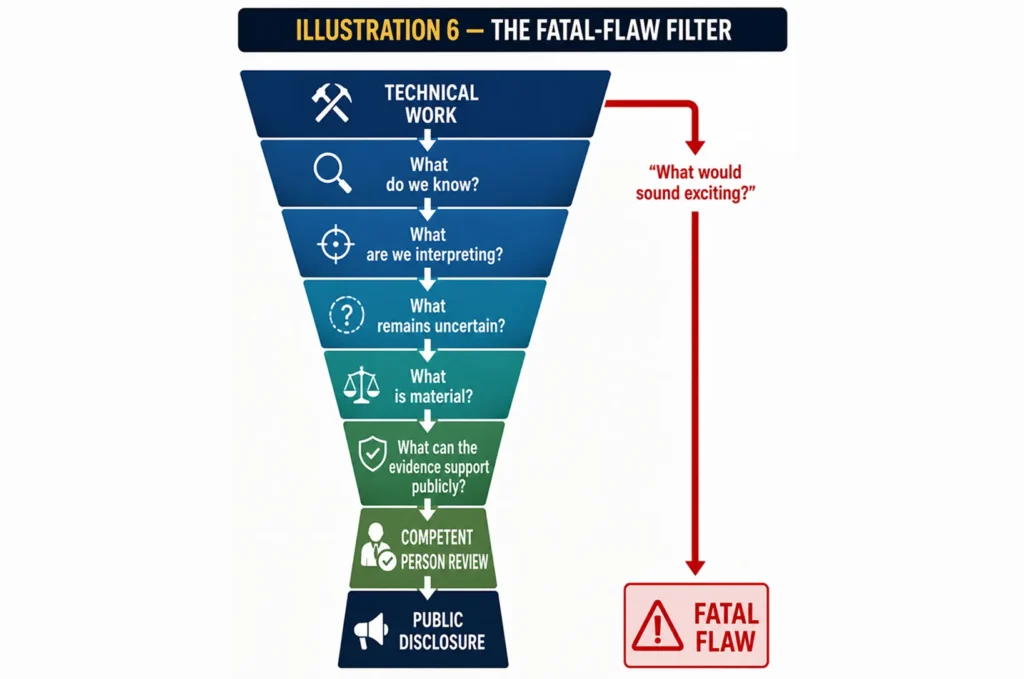
The Ten-Minute Fatal-Flaw Test
Before a mineral announcement is released, somebody who understands both the geology and the disclosure framework should be able to answer ten questions.
- What is the single most important technical claim being made?
- What evidence supports it?
- What evidence qualifies it?
- Have fact and interpretation been clearly separated?
- Is the terminology appropriate to the project’s actual stage?
- Have unsuccessful or contradictory results been treated fairly?
- Would the figures create the same impression as the text?
- Is the Competent Person genuinely competent for this particular work?
- Does Table 1 explain the material context?
- Would we still be comfortable with every sentence if ASX asked us tomorrow to explain exactly what we meant?
If one of those questions causes the room to go quiet, the announcement is not ready.
Compliance Is Not the Opposite of Promotion
There is a persistent fear that rigorous technical reporting makes an exploration story dull. It should not.
A genuinely significant discovery remains significant when presented accurately and a strong intercept does not become weaker because the drilling geometry is disclosed.
A compelling target does not become less compelling because it is clearly described as conceptual and a robust resource does not become less valuable because its assumptions are visible.
Quite the opposite, specificity creates credibility.
Compare:
“Outstanding drilling confirms a world-class discovery with enormous upside.”
with:
“Drilling has extended mineralisation approximately 300 metres along strike, with the system remaining open to the north and at depth. The current drill spacing is insufficient to establish continuity outside the drilled area, and follow-up drilling is planned.”
The second sentence is less theatrical.
A technically sophisticated investor can see exactly what has been achieved, what remains uncertain and what the next program is intended to test and that is not weaker promotion, it is better communication.
Credibility Is a Geological Asset and a Financial One
Mining companies spend enormous amounts of capital reducing uncertainty. They drill another hole, collect another metallurgical composite, refine the geological model, commission geotechnical drilling, improve density data and increase confidence in the modifying factors that ultimately shape development decisions. All of that expenditure has one underlying purpose: to make important decisions using better information.
Public reporting should do the same thing for investors. When disclosure is consistently precise, balanced and technically disciplined, investors learn how to read a company. They begin to understand which statements describe direct observations, which reflect geological interpretation, which remain conceptual targets or estimates, and which conclusions have actually been demonstrated by the available evidence. Over time, that consistency becomes valuable because the market develops confidence not only in the project, but also in the way the company communicates uncertainty.
The opposite is equally true. Once a company develops a reputation for promotional language, selective reporting or conclusions that repeatedly run ahead of the evidence, every subsequent announcement begins to attract an unofficial discount before the reader reaches the first table. Even genuinely good results can arrive carrying a credibility haircut.
FrontFinders’ View: Build the Disclosure While You Build the Dataset
The best time to discover that an announcement lacks essential technical information is not the afternoon before release.
Disclosure quality begins in the field, and it begins with sample identification, collar surveys, recovery records, sampling protocols, photographs, QA/QC, logging, interpretation and database control.
When those systems are strong, disclosure becomes considerably easier because the evidence trail already exists. When those systems are weak, no amount of elegant writing can repair the technical foundation afterwards.
At FrontFinders, we therefore see public reporting as the final link in a much longer chain:
field practice → data quality → geological interpretation → professional judgement → defensible disclosure.
Break the chain anywhere and the problem eventually reaches the market.